

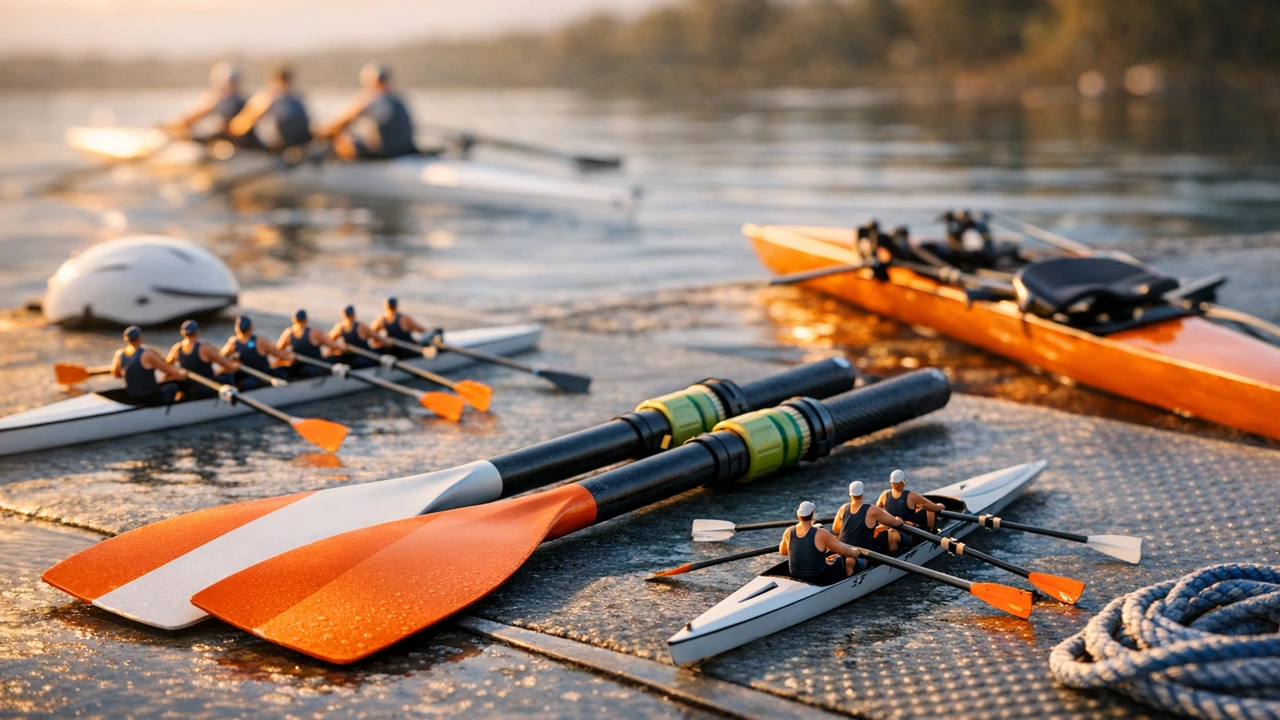
Types of rowing differ by stroke mechanics, boat class, water conditions, and competition format. That sounds basic, but the distinction matters immediately: an athlete who moves well in a single scull may struggle in an eight, and a flatwater specialist will not automatically adapt to coastal rowing. If you want to understand the sport properly, the key split starts with how the oar is handled and what kind of boat carries the crew.
Modern rowing now sits across several clearly defined branches. Olympic regattas still shape the public image of the sport, yet indoor racing, coastal events, para-rowing, and recreational formats have expanded the landscape. Each version places different demands on technique, balance, power output, and race strategy.
Main types of rowing by stroke style
The core division in rowing is simple: sweep rowing uses one oar per athlete, while sculling uses two. That technical difference changes body timing, boat setup, crew composition, and the way speed is built through the water.
Sweep rowing
In sweep rowing, each rower holds one oar with both hands. The oar sits either on port or starboard, so crews must balance the boat through coordinated force rather than symmetrical individual movement. This is the format used in coxless pairs, coxed pairs, coxless fours, coxed fours, and eights.
Sweep boats usually demand sharper crew synchronization because every imbalance shows up immediately in run and set. The eight is the fastest conventional rowing shell, and elite men’s eights can cover 2,000 meters in roughly five and a half minutes under top conditions. That speed comes from crew mass, clean catches, and precise rhythm, not just raw strength.
Sculling
In sculling, each athlete uses two shorter oars, one in each hand. The motion is more symmetrical, which often makes sculling easier to learn at entry level, though high-end sculling is technically unforgiving. Boat classes include the single scull, double scull, and quadruple scull.
The single scull is often treated as the purest technical test in rowing because the athlete controls balance, steering line, stroke length, and race pacing alone. A small timing error in a quad may be absorbed by the crew; in a single, the boat tells on you immediately.
Boat classes and what they mean
Boat class names in rowing combine crew size, whether the boat is sweep or sculling, and whether a coxswain is present. Once you understand the notation, race programs become much easier to read.
| Boat class | Type | Crew size | Coxswain | Typical use |
|---|---|---|---|---|
| 1x | Sculling | 1 | No | Technical development, solo racing |
| 2x | Sculling | 2 | No | High-speed crew sculling |
| 4x | Sculling | 4 | No | Elite regatta racing |
| 2- | Sweep | 2 | No | Pair racing, technical precision |
| 4- | Sweep | 4 | No | Power and rhythm balance |
| 4+ | Sweep | 4 | Yes | Traditional crew racing |
| 8+ | Sweep | 8 | Yes | Maximum speed, championship racing |
The symbols matter. The number shows how many rowers are in the shell. The x marks sculling. A plus sign means the boat has a coxswain, and a minus sign means it does not. In practical terms, a coxed four and a coxless four are not minor variations of the same event; they are different tactical environments.
Flatwater rowing and Olympic racing
Flatwater rowing remains the reference point for international competition. Standard championship racing takes place over 2,000 meters in multi-lane courses, where crews must combine explosive starts with controlled middle sections and a hard final sprint.
This is the format governed at the highest level by World Rowing and used in the Olympic program. Conditions are designed to reduce external variables, so the race should reward speed, efficiency, and lane discipline rather than survival skills in rough water. Even then, wind direction, tail current, and temperature still influence times.
Olympic rowing has also changed its event mix over time. Lightweight rowing, once a major competitive branch, has lost ground at the top end. That shift reflects wider pressure toward event simplification and gender balance, but it also affects athlete pathways. A rower who once targeted lightweight double sculls now often has to move either into open-weight categories or toward other formats.
Coastal rowing and beach sprint formats
Coastal rowing is one of the clearest growth areas in the sport. It uses wider, more stable boats built for waves, wind, and open-water movement rather than sheltered regatta lanes.
Traditional coastal races can cover several kilometers with turns around buoys and variable sea states. That changes everything. Crews must read water texture, manage boat angle into chop, and protect rhythm when the hull slaps or lifts. Technical purity still matters, but adaptability matters more than it does on a calm lake.
Beach sprint rowing has pushed coastal rowing further into the spotlight. In this format, athletes start on the sand, run to the boat, launch through surf, row a short slalom-style course, return, and finish with a beach sprint. It is faster to watch, easier to package for broadcast, and much more chaotic than standard regatta rowing. For spectators, it is one of the most accessible rowing disciplines because mistakes are visible and the race shape changes quickly.
From a training perspective, coastal specialists need more than aerobic base and stroke repetition. They need acceleration off unstable catches, strong steering awareness, and comfort under uneven loading. A flatwater rower can transition, but not by treating coastal racing as a rougher version of the same thing.
Indoor rowing and ergometer competition
Indoor rowing is rowing without water, but not without structure. It uses ergometers, most commonly the Concept2 machine, to measure distance, pace, stroke rate, and power output in a controlled environment.
For many clubs, indoor rowing is the backbone of winter training. Coaches use standard tests such as 2,000 meters, 5,000 meters, 30 minutes, or fixed-rate pieces to assess fitness and track progression. The famous 2k erg test remains a benchmark because it correlates strongly with race capacity, although it does not replace technical boat speed.
Indoor rowing has also become a competitive discipline in its own right. World-level erg racing now includes individual events, relays, age-group categories, and virtual formats. The athlete profile can differ from on-water rowing. Some competitors produce elite machine scores but lack the balance, bladework, or crew feel required in a shell.
That distinction matters for beginners choosing a path:
- Indoor rowing is easier to access because weather, water safety, and boat storage are not barriers.
- Ergometer training gives clean data, which helps with programming and comparison.
- On-water rowing still decides technical level, especially in sculling and small boats.
- Strong erg numbers do not guarantee race results in real conditions.
Adaptive rowing and para-rowing classes
Adaptive rowing, usually referred to in elite competition as para-rowing, is structured for athletes with physical, visual, or intellectual impairments under defined classification rules. It is not a side branch with loose standards; it is a regulated part of the sport with specific equipment adaptations and race categories.
At the international level, classes are based on how much trunk, leg, and arm function the athlete can use in the stroke. Some rowers compete with fixed seats and chest support, while others row with sliding seats closer to conventional technique. Mixed-gender crew formats are common in para-rowing, which gives the discipline a distinct competitive identity.
The practical point is that adaptive rowing changes equipment setup, but it does not lower technical demands. Athletes still need timing, pressure control, aerobic capacity, and race execution. In many programs, para-rowing has also widened club participation because it pushes facilities and coaching systems to become more flexible.
Recreational, touring, and traditional rowing
Not all rowing fits the regatta model. Recreational rowing includes stable training boats, touring shells, fixed-seat boats, and club sessions built around fitness, skill learning, and time on the water rather than race results.
Touring rowing often involves longer distances, mixed water conditions, and practical boat handling such as landing, carrying, and navigation. Traditional rowing varies by country and can include coastal workboats, river skiffs, gigs, or fixed-seat community boats. These formats preserve local technique and boat design, but they also serve a modern function by bringing more people into the sport without forcing an immediate jump into racing shells.
For adults entering rowing late, recreational pathways are often the smartest starting point. A stable coxed quad or training double lets athletes build sequencing and confidence before they deal with the instability of a racing single.
How race distance changes the discipline
Race distance is one of the clearest filters between rowing types. Standard flatwater championship racing uses 2,000 meters, but not every discipline follows that model.
Beach sprints are short and violent. Head races on rivers can run 4 to 8 kilometers or more, usually against the clock. Indoor rowing events range from 500 meters to the marathon and beyond. Recreational tours may last hours. The physiological demand shifts with the format: a 2k race mixes power and endurance, while a long head race rewards pacing discipline and technical economy under fatigue.
This is why athletes do not move between formats as easily as outsiders expect. A strong 500-meter erg specialist may fade badly in a 6-kilometer head race. A rower with excellent long-distance rhythm may lack the start speed needed in championship sprint structures.
Which type of rowing suits different athletes
The best rowing format depends on body profile, technical background, access to water, and competitive goals. There is no universal progression that fits everyone.
Athletes with strong balance and patience often develop well in sculling, especially in singles and doubles. Larger, more powerful rowers may thrive in sweep boats where crew mass and synchronized force create high hull speed. Younger athletes often start in quads because the boat gives enough stability for learning while still teaching bladework. Masters rowers frequently combine recreational water sessions with indoor training to manage volume and recovery.
These checkpoints help narrow the choice:
- If access to calm water is limited, indoor rowing or coastal rowing may be more realistic than flatwater racing.
- If technical independence appeals to you, sculling offers more direct control over the boat.
- If you prefer team rhythm and shared race execution, sweep rowing usually fits better.
- If physical classification affects equipment needs, para-rowing pathways provide structured competition.
- If the goal is fitness rather than regattas, recreational and touring formats are usually the most sustainable option.
Choosing the right rowing discipline
Types of rowing are best understood as separate disciplines linked by a common stroke cycle, not as minor variations of one sport. Sweep and sculling form the technical base, flatwater racing defines the classic championship model, coastal and beach sprint events expand the sport into rougher environments, indoor rowing supplies measurable training and standalone competition, and adaptive rowing ensures structured access across classifications.
For a beginner, the practical choice should start with conditions and coaching rather than image. Pick the format your local club can teach well, the boat class you can row consistently, and the discipline that matches your body and schedule. That approach usually leads to faster progress than chasing the most visible version of rowing from the start.


Leave a Reply